
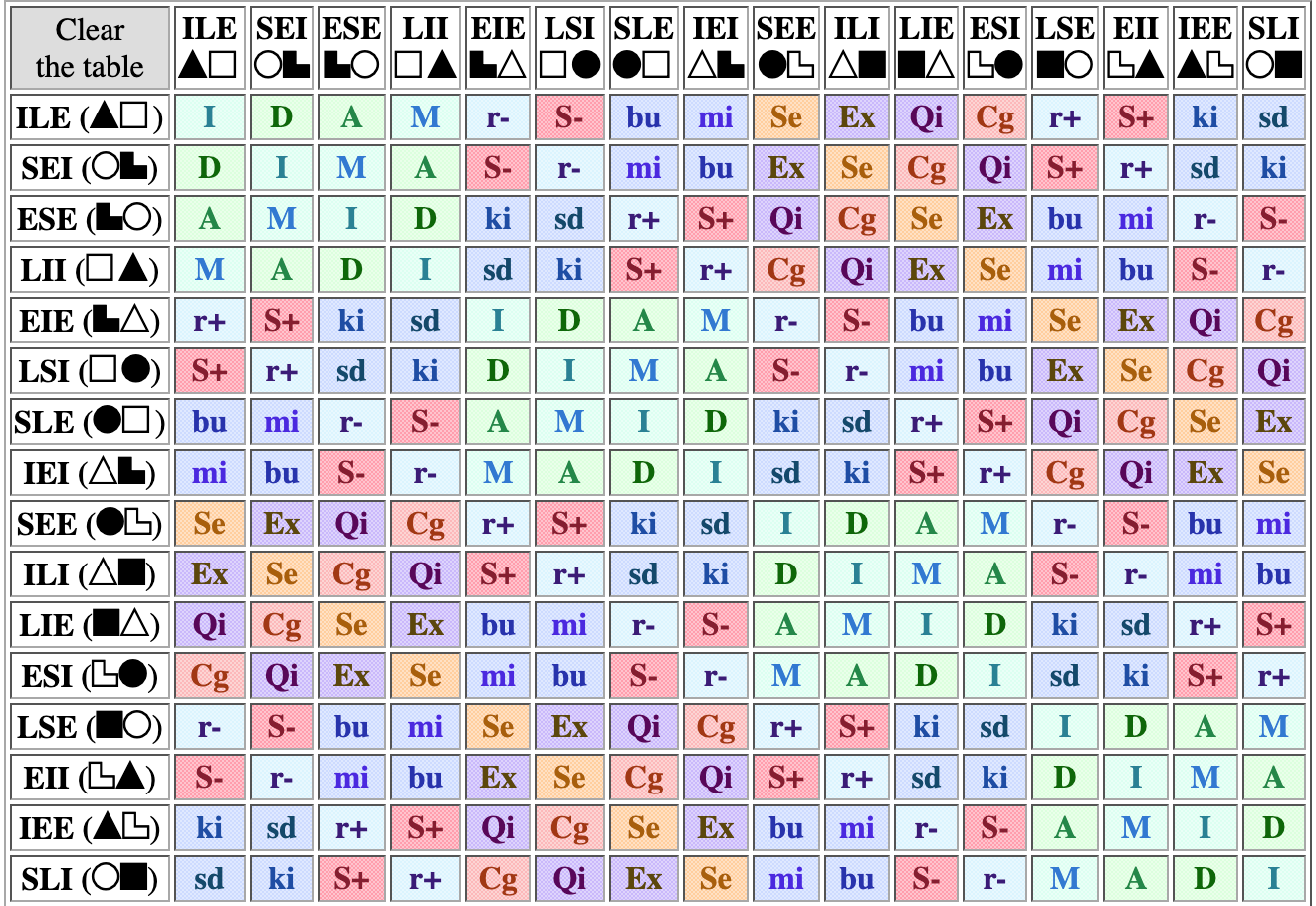
I am breaking Socionics dogma simply with this title, aren’t I? Duality is nearly worshipped by many who understand Augusta’s framework. Forums abound with people looking for duals, analyzing interactions with their duals, and even discussing leaving current relationships so that they can be with a dual they met. I think that the Socionics community over-focuses on a specific, Westernized, contemporary type of love: a relationship that is smooth, low-context, low-intensity, and “positive”. Duality allows you to achieve the modern ideal of each partner being independent and not truly needing the other, and of one partner never feeling asymmetrically protective of the other.
That’s not how love has been in any era except ours, which is characterized by frictionless digital ease and aggressive outsourcing of emotion to specified institutional boxes. It is now common, and considered “caring” in some circles, to tell someone, without any attempt to be a real, loving friend, that they should just go see a therapist.
We have fundamentally lost our sense of the reality of human weakness. Where is the art about life being inherently fragile – such as the medieval Danse Macabre – in this day and age? It is rare to find, and has been replaced by bombast and gaslighting that tries to play linguistic games so that every emotion is somehow “not weakness”. Our world has tried to socially outlaw the basic state of human nature.
Socionics has also over-emphasized romantic relationships as the only type of love. Many of the deepest colors of intertype relationships come out in other types of bonds, especially friends who are soul-matches and who are both gifted and atypical, as well as parent-and-child bonds. Both are some of my favorites to study. In keeping with that, though I truly value romantic love and believe that it is something to be longed-for and cherished, I will not use “love” as a synonym for romance in this article or in any of my other writing.
Why Duality doesn’t always work
Typical intertype relation calculations assume that all pairings of a relation will feel the same, just with a different flavor each time. In other words, Augusta and other scholars treat all Information Elements (Ni, Se, Fi, Te, etc.) as equally powerful in deciding how a relationship will be, without taking into account each IE’s peculiarities. Some IEs are objectively more intense and more externally forceful than others. Accentuating the base or the creative to determine a subtype will have a dynamic effect depending on what IEs are being emphasized. You cannot follow one-size-fits-all rules when determining the quality of intertype relations.
LSE and EII: Interchangeable Comfort
Let me give an example. LSEs and EIIs tend to get along regardless of whether they are both the base subtype (Te and Fi), both the creative (Si and Ne), or one and the other (Te and Ne or Si and Fi). Even though the Te subtype of LSE can be aggressive if not well-developed, the Fi subtype of EII often matches this in a strange way: what I like to call the “EII bulldog.” These EIIs slant more towards the Gamma Quadra, and they approach ESI because their Se PoLR is strengthened compared to the Ne subtype. This type of EII can take on a subtle but perceptible hard edge or lack of sensitivity. They may, in a calm voice with a bit of street-smart vocal fry that seems surprising for them, agree with a harsh judgment or express support for revenge. There is a modern casualness about them that the EII-Ne lacks; this is especially evident in style of dress.
When an LSE-Si interacts with an EII-Fi “bulldog,” they either repress their emotions (ironically pleasing the EII-Fi’s inward containment) or they use their demonstrative Se to provide an atmosphere of playful hardness that the EII-Fi easily accepts. When an LSE-Te interacts with an EII-Ne, if both types are well-developed and sympathetic, the LSE’s strengthened Ni PoLR can make them into a grave, duty-bound protector for the frail, pure-hearted EII-Ne. They are slightly more aware of their archetype as an old-world guardian, and their activating Ne is stronger, both of which make the LSE more able to engage with the EII’s inner dream-world.
SEE and ILI: Invigorating or Unbearable
An example of a dual relation where this equivalency does not apply is the ILI and the SEE. The SEE is the more emotionally and psychologically dominating partner in this relation because of their base Se, so their subtype will have an asymmetrical impact on the comfort of the relation.
An SEE-Se and an ILI-Ni is not a dream relation. It is exhausting for the ILI and boring for the SEE. The SEE-Se is frequently shallow, loud, aggressive, materialistic, and focused on hedonistic pleasure. They have a cynical approach to social relations: many SEEs are clique leaders and self-aggrandizing gossips. The ILI-Ni, on the other hand, is often not cynical. They may appear guarded on the outside, but they live in a historical and thematic inner landscape built over time. They guard their private bonds fiercely, and they do not want anyone encroaching on their time with social games. Their Hidden Agenda is to love and be loved in a personal Fi way (“loyalty”), not in a broad Fe way (“belonging”). When an SEE-Se and an ILI-Ni meet, there is no synergy. The ILI rejects the SEE out of distaste, and the SEE completely ignores the ILI. They try to talk and there is no shared ground.
The situation changes, however, when the ILI has a Te subtype or the SEE has a Fi subtype. (ILI-Te and SEE-Fi do not get along, by the way.)
SEE-Se and ILI-Te would be like Julius Caesar and Henry Kissinger. They would both see the world as a chessboard of power and leverage that they can manipulate for mutual conquest. The SEE-Se provides the force, charisma, and social maneuvering, and the ILI-Te provides the cynical opposition research, the long-term planning, and the cutthroat execution. Together, these two would rule an empire that, to my SLI mind, would be unethical and cruel, but to them would make perfect sense as the way to get ahead in the world.
SEE-Fi and ILI-Ni are a much sweeter and more tender relation. Picture a somber, intellectual, but sensitive father or grandfather with a giggling son or grandson who loves people and spreads light with his smile. This SEE is not loud or overwhelming. Because Fi and Ni are accentuated, his Se is transformed from forceful power into joyful vitality, and his energy brings the ILI out of his shell and helps him to feel emotion. Even if the SEE is not consciously a philosopher, the ILI father or grandfather treasures him, sees an unexpected philosophy of life in his active presence and empathy, and would never want anything to snuff out his beauty.
Where does Supervision come in?
It’s a less-discussed and supposedly negative intertype relation. It’s said to feel oppressive and shaming for the Supervisee, and painful for the Supervisor. Why, then, would it be better in some cases than Duality?
The answer lies in the fact that Supervision is one of the relations that is given the least accurate treatment by classical Socionics.
Not all Supervision relations are positive. There are certainly rules. An EII-Ne and an SEE-Se will not get along. An EII-Fi and SEE-Se, however, would be comfortable, especially since the EII would be a “bulldog”. Any expression of Se would chafe too much against the EII-Ne, and the EII-Fi would find the SEE-Fi’s gentleness unsatisfying, as they have that paradoxical desire for sharpness. SEE-Se to EII-Fi, in fact, is the same Delta Introvert-Gamma Extravert relation category as my very favorite Supervision relation to discuss – SLI-Si and LIE-Ni. That, of course, happens to be my own Supervision relation.
You’ll notice something: I am warning against Supervision relations where one type has an Se subtype, but not other cases. I’m doing this because Se is a particularly “loud”, potent IE that is more polarizing than all other IEs, except for maybe Fe.
In the cases where Supervision works, there is a general rule for the best pairing: the Supervisor’s subtype is the Supervisee’s PoLR, and the Supervisee’s subtype is introverted.
When this rule is met, pure magic can happen. I want to explain my favorite type pairing now, LIE and SLI. This pairing is often better than duality on both sides. I want to explain my favorite type pairing now, LIE and SLI. This pairing is often better than duality on both sides.
The Beauty of the SLI-Si and the LIE-Ni
I have known LIE types in my life. Except when they have been truly unhealthy, I’ve felt a magnetic pull toward them, and they have sought special understanding and companionship from me. They feel safe and yet engrossing in a way that my dual, the IEE, does not. Being loved by an LIE feels like being at the center of a spinning orange reactor, completely safe from the world outside while watching a dizzying light show from inside. The energy between an SLI-Si and an LIE-Ni never feels quiet, and a mature LIE-Ni feels like a bottomless container and a tireless responder for their loved ones’ distress.
One of the most profound things about an LIE-Ni, especially for an SLI-Si because of Fe PoLR (which makes it difficult to initiate conversations or feel comfortable in the social realm) is that an LIE does not forget about you. Their energy is not passive enough to let you disappear when you don’t say anything. Yet, because they don’t have conscious Fe – unlike the overwhelming EIE-Ni, their Kindred (Kindreds often don’t get along; more on that in another post) – their intense love does not feel smothering. It is high-pressure and enveloping, but in a way that an SLI can process because it is routed entirely through Fi expressions of loyalty and Te requests (like asking specific questions about you rather than forcing an open-ended emotional disclosure).
SLIs are not supposed to be mystical – or so they say. What Socionics forgets is that the SLI stack has Role Ni, which is closely related to Suggestive Ne. The Role function can be a way to explore the Suggestive. Information coming through the Suggestive is often expressed through the Role, and expressions exiting from the Role can allow someone to feed their Suggestive without needing outside stimulation. What this means is that the LIE’s Ni insights, especially in the more reflective and melancholic Ni subtype, which is less focused on business and more focused on literature and spirituality, feel like catnip – and also like an organizing structure – for the SLI’s Role Ni and Suggestive Ne.
This can be extremely valuable for a type that is used to being the grounding wire for others, yet often has nowhere to take their intuitive musings except the scattered IEE, who often just validates and extrapolates on them without providing structure or interpretation. The LIE, on the other hand, is a safe place to land who can seamlessly switch from discussing spiritual thoughts to asking with a shaking voice if the SLI was out walking alone at night, and saying “You know I worry. You know I need to hear that you’re safe.”
That brings me to my final point: the nature of Se in the LIE, and how it delicately interlocks with the SLI’s Ignoring Se and Activating Fi.
The somber Gothic completeness of the SLI and LIE’s implicit “just war” philosophy
The Ignoring function is an unvalued but strong function that is essentially kept in a back pocket until it must be used. Each type considers it gauche, overt, or coarse to talk about their own Ignoring function except with great care. It is in the same category as the base function (S, N, T, or F), but the opposite orientation (introverted vs. extraverted). So, the LIE’s ignoring function is Ti (which deals with structure, ideology, and internal logical justification), and the SLI’s is Se (which deals with force, territory, vitality, and power).
I had described the energy between the SLI and the LIE as always active. It has a zinging, trembling quality. There is the feeling that the two of them are always on the verge of an outpouring in each other’s presence, and this does sometimes happen. An open energetic loop exists in which the Ni-Fi narrative of the bond must be closed from time to time with decisive action. This loop often goes unspoken between the SLI and the LIE, except with exchanges like this:
SLI: Is everything… all right? I was remembering that time when –
LIE (whispering, with a voice that sounds like a taut wire): I know.
(pause)
LIE (softer): Don’t worry. Please don’t worry. I- I will take care of you.
(The SLI looks up at the LIE with wide eyes, knowing the potential for an intense response, which is latent in the LIE’s expression.)
SLI: I suppose – I suppose there’s not much else – (bites lip).
(LIE nods his head gravely with sorrow in his eyes, envisioning a firm boundary being set between the SLI and the enemy.)
(end of scene)
You can see the Gothic interpersonal physics here. The LIE is like a powder keg. He is inherently activated by this variant of the SLI, in their passivity and vulnerability. (There is another variant of SLI, which can occur in either subtype, which is stronger and more self-contained, but the LIE-SLI bond works most vividly when the SLI is frail.) A frail SLI, especially when they implicitly suggest and draw out the LIE’s Se instinct, forms the perfect Ti argument to justify the deployment of Se.
There’s also an emotional element here. SLIs have activating Fi, which endlessly seeks validation of Fi bonds, yet they need the validation to come from anything but Fe (overt, intentional emotional expression, especially when it feels planned or curated, or, conversely, unhinged or transgressive). SLIs are often ignored and unappreciated by the people around them. With their vulnerable nature and their quiet Ignoring Se, and their need for an undeniable sign that someone loves them, their Activating Fi forms a loop with the LIE’s Mobilizing Se. The LIE’s Se finally feels like enough. Here is someone who is willing to be completely unmoored by the SLI’s pain and is longing to show their love (Role Fe as a processor/expressive function that feeds Suggestive Fi) by giving the SLI the unyielding loyalty and protection they may have never had.
Whenever the loop is completed by the LIE’s crusades, the Ni-Fi narrative of their relationship – which is often one of an intense protector and a sweet one who is cared for – finds an external fulfillment and validation, and they both are drawn deeper into the meaning they have created together. A crucial element of this is the LIE’s role as the Supervisee of the SLI. Rather than this structure making the SLI the protector, the LIE rather becomes the SLI’s fiercest guardian, as the SLI becomes to the LIE a paragon of quiet morality, peace, and dignity. The LIE looks to the SLI for spiritual and philosophical guidance, and considers his lack of total comfort around the SLI to be good for his character, because he feels he is being reformed by simply sitting in the SLI’s presence.
This is why I call the SLI and LIE relationship, in all its forms, the “Jane and Rochester exception” to the classical laws of Supervision. I am grateful it was so enshrined in classic literature, and I hope that this article was an appropriate ode to it and also an informative introduction to my theory of Dynamic Socionics.