
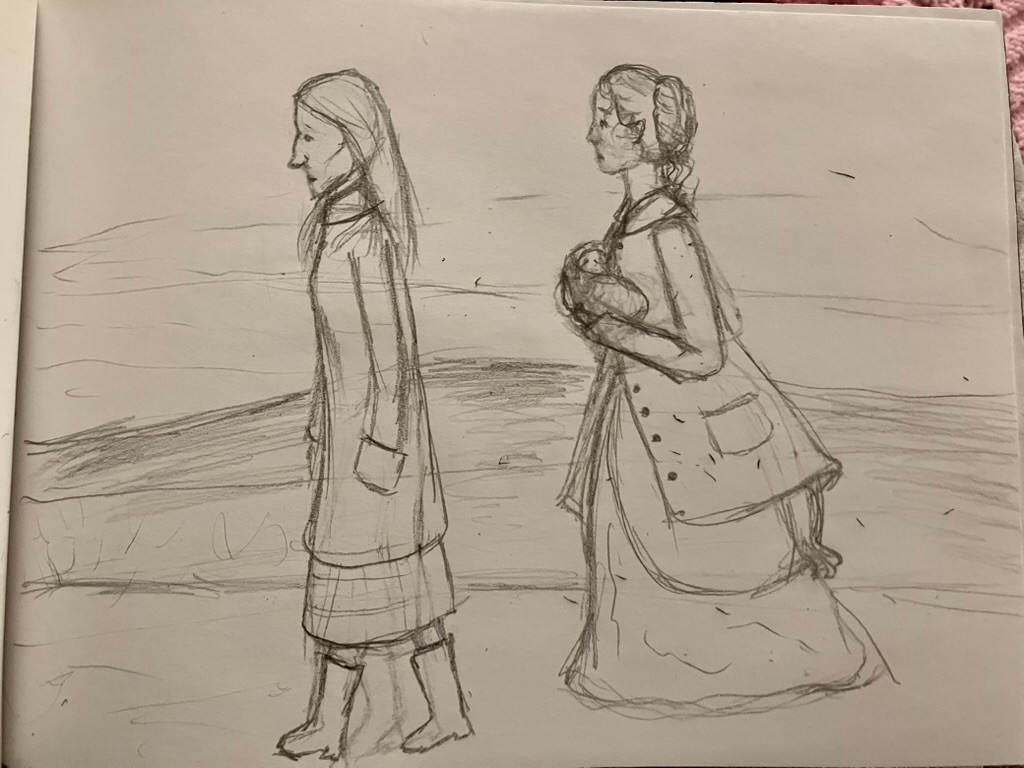
This is from a Descendants rewrite that I have been working on for a long time, called A Mind of Its Own. The title refers to the sentience and moral judgment of the Barrier in independently admitting certain good-hearted individuals from the Isle who cross the bay into Auradon in the night. This story is a Victorian Gothic spiritual novel that takes the core concept and gives it much more weight than the original Disney Channel movies.
In this chapter, Claudia Frollo, the sweet daughter of Claude Frollo who has gone to Auradon in a desperate search of a safer life, meets an old acquaintance on a brief return visit.
I will post more of this story, including building up the long series of chapters before this “in medias res” introduction, over time.
—
Claudia had been walking along the seaside for quite a while. Rose lived directly in front of the dock where she had taken flight, and she was sleeping there during this short return. She had accepted her on sight, without asking questions – save for “Did you find my mother yet?”, “Have you been happy? Have you been safe?”, and “You have not been formally removed, have you?” Similarly to before – almost a year ago, if Claudia could believe it – Rose’s presence, and the fact that she lived on the coast, a full two miles from town, meant that Claudia had quite a strong chance of evading her father’s sight.
It hurt to think that. It felt wrong. Surely she had not changed so much from the girl who had agonized over leaving and had written that note through tears, and who had had to make herself partially relive – that encounter – in order to convince herself that she truly had to leave.
I doubt that I’ve changed so, Claudia reflected. I have felt like the same person all throughout. I have often thought of Father, wished I had not left, felt that I needed to leave, and then dreamt my memories of his love, all in the span of a few hours.
What Claudia feared was not him knowing that she was there. She feared seeing the mixture of his anger and, most significantly, his love and his severe grief upon losing her. She did not have to see his response to her departure to know that he was shattered by it – that he paced wildly about the house that morning, choked with tears, and then tried to wring any detail he could out of every living being on the Isle. I wonder if he spoke to Rose and Robert, she thought with a sigh. I hope he did not mistreat them. It was as far as she could go without buckling from the growing tightness in her stomach.
Despite the suffering she had endured thus far in Auradon, she knew that she had found kindness there that would not be possible in all but the most hidden corners of the Isle, which she had already dug up.
If she walked into her father’s house – or within the perimeter of it – she would never be able to leave again.
He might not lock her in the house. But he would erupt with eleven months’ worth of despair and longing, and he would convince her that it truly was better to be with him. He would tell her how he had worried desperately about her, not been able to sleep, thought of her every waking moment. She would melt with guilt for having hurt him thus.
Surely Claudia was being selfish and refusing to look the truth in the eye. Those thoughts did not change the course of her steps, but they did not stop a pit from forming deep in her gut. She could not face him.
She continued northward along the seaside road.
She did not think about where she was going – walking a section of the perimeter of the Isle, as long as she remained out of the sight of her father, was enough. She looked down at the road, keeping her head up just enough to see what was going on around her (which was nothing, at the moment – just trees and empty moor). It was silent for a long time as she walked.
I look, and still feel, frail, Claudia realized, but throughout the past year, I’ve been forced to walk many miles alone and without stopping. It has not improved my endurance; it has only made me quite exhausted. Some would think that impossible. I know my constitution, which does not respond to pain with strengthening itself, is not the one spoken of as ‘universal’.
The trees rustled in the wind, and slowly they thinned out to reveal an empty stretch that felt deserted and rather forbidden. To her right, Claudia could see the slowly sloping hill of grass that turned into rocks and sand as it neared the water’s edge. She was not looking to her left. And then:
“Stop.”
Claudia startled, and was afraid to look to her left to see where this bright, full, desperate voice had come from.
“Oh, you won’t turn around? I see,” the voice continued. It sounded frantic, angry, and pained, yet also distant. It rung like a bell that Claudia had long forgotten about. “I suppose you’d rather not see the waking spectre, the shell, that is evidence of the one truth you will not name.”
Claudia, unthinkingly, checked her pockets to see if she had a small trifle to give. A spine that suddenly felt like inflexible steel grounded her in her position facing away from the young woman, whom Claudia was sure was Petra Ratigan. It must just be her walking along the road, Claudia tried to reason with herself. You have seen her many times before. Why is it so frightening to think of looking at her? You are, after all, near her father’s property.
“Petra…” she began quietly, “I don’t know exactly what happened, but…”
Petra finished her sentence for her: “But you can answer your own question by simply looking across this road.”
Claudia closed her eyes before she turned. It felt like a step toward looking her in the eye – she could allow herself to physically turn while still shielding herself from the shock she felt was awaiting her.
“Come now, little waif,” Petra called out with an edge of mockery in her tone. “I know it is frightful to look upon a soul who holds a book of Psalms and dares to expose her forearms and collarbone.”
Claudia felt herself blush and her torso fold in on itself before she could control it. It was not the idea of a woman exposing her forearms and collarbone that caused her reaction – Claudia did not believe that was wrong, but she still never did so. A long shadow cast over a person for years makes their whole body afraid to step into the sun.
What made her blush was how thoroughly Petra knew her, despite having only interacted with her a few times – and how well she remembered Claudia’s social and psychological history, built from accurate inferences, despite Claudia having been away for almost a year.
She breathed in deeply.
When she slowly opened her eyes, she did not speak for a very long time. Her mouth was not open in a dramatic sense, but rather, it hung loosely and slightly open, and she did not bother to attend to it.
A worn, thin blanket, with dirt specks dotted all across it, lay on the ground across the road. There was no tent or covering. On the blanket sat a single black wrought-iron lantern, unlit at the moment. There appeared to be an outhouse and dressing room in one, “built” by hanging long sheets from different branches of two trees. The only “pillow” was a bag filled with a few things, arranged such that the resulting curve would support Petra’s neck. A few books lay on the ground. There was almost no food, just some berries, nuts, and seeds that Petra had apparently foraged. A large trunk was the only object of substantial size, and Claudia guessed that it contained clothes and necessities. There was one more bag that appeared to have a lock on it.
And then there was Petra.
She did not look healthy.
She had always had high, graceful cheekbones, and her cheeks were never too full, but they now looked as though the skin stretched over an empty hole. Her hair was matted and dirty; Claudia could see sand in it. It was unpinned, and it looked like it had been so long since she had bathed that the grease had calcified and no longer shone.
Her eyes had dark circles under them that seemed to reflect the pressure of her eyes sitting inside a frame that was struggling to support their weight. She sat still enough for Claudia to be a bit disturbed. Her lips did not move; she did not snap at Claudia. She had no wisecrack burning on her tongue – Claudia could tell. As if she were holding a personal journal behind her knees that she did not want anyone to see she was reading, her tense legs covered her stomach and breast, and her feet sat flat on the ground. She leaned forward and down at herself, while still looking up and directly into Claudia’s eyes.
“You have brought me to ruin,” Petra said, without any fire.
Claudia noticed that the skirt of Petra’s dress was ripped and torn, and that Petra had attempted to mend several of the tears herself, until she (presumably) ran out of thread.
All that Claudia could think to say that would not be disrespectful or arrogant was this: “I have no words that could act as a balm for your situation. I do not come claiming answers or solutions, or claiming to know what God thinks. I do not believe he made this happen to you.”
“Do you believe,” Petra’s voice dropped to an agonized whisper, “that he walks by me every day, and never says a word – that he has the audacity to look at me, to pass me by, and not atone?”
Claudia did not need to be told who “he” was. She simply knelt down next to Petra, but not close enough that she might feel intruded upon.
“He is difficult to understand,” she said. “He seems to turn unreadable and still precisely when others would show emotion.”
“Yes,” Petra said, after a pause and a slow blink.
Claudia’s eyes happened to dart toward Petra’s torso, which she noticed was starting to swell – unlike the rest of her, which was painfully thin. She did not say anything about this observation. She knew Petra would think that she was naming her as a “fallen woman”. Petra could not feel the cold sweat coming over Claudia, nor was she privy to the drop in Claudia’s center of gravity toward the place in the gut where the deepest shades of moral disturbance settle unspoken.
Claudia was still – utterly still. She closed her eyes. The sound of both of them breathing rustled gently through the air for quite a bit of time.
“I apologize for my appearance.”
Claudia opened her eyes with disbelief.
“It has not rained in several days,” Petra continued quietly. Even in this state, her voice still had a gentle lilt, and Claudia caught the triplet rhythm on “it has not”. “When it rains, I go inside the dressing room over there and take a shower of sorts.” She sighed. “It is enough.”
“How long have you been here?” Claudia ventured to ask. Her voice was gentle. Petra looked over at her. The edge in her eyes was not hatred, but the ironic look that only appears when someone who’s made you suffer is now asking about your suffering.
Her answer was indirect. “He always called this place a prison of rocks and dead earth. I think, eleven months and six days ago, you and I traded cells.”
The slowly building winds from the northwest continued to swirl in Claudia’s insides. She blinked and looked out at the road, rather blankly.
She treaded this territory gingerly. “I remember the desperation in your eyes, and the tightness in your jaw when you finally made the decision.”
Something seemed to numb slightly in Petra’s eyes.
“Was that indeed what you remembered?…”
Claudia nodded. “I also remember how you seemed to try to stretch out time for as long as possible, and how slowly you began walking home.”
“I would ask why you put me in such a position, but I do not think either of us claim to have full control over our fates, and I have seen too often that our sense of ‘wisdom’, as we call it when we are sane, decides to dull herself when she would be most useful.”
Claudia’s brow furrowed softly. “Sometimes, Petra, I have the same thought when I question whether I should have left. I have not been triumphant, or even particularly happy, for the past year.” That was a risk, she thought immediately. The first word I will hear from her is ‘good’.
Petra loosened her posture a little, allowing her stomach to show slightly more. Claudia did not take advantage of this fact to comment, though – that would be the equivalent of spitting the name of someone’s loved one out of her mouth as soon as she had been let in on the secret.
“Very few, if any, safe places for someone with so strong a resemblance to your father as you?” Petra asked, surprisingly softly.
Claudia nodded, touching her nose without trying, and looking down at herself. She sighed in the sort of controlled way one does when it is not a full release, but rather recognizing, without much hope, the depth of tension inside her.
There was a thick silence for a while. Claudia’s center of gravity continued to intensify; she felt as though a stone were weighing down her whole body. I should have allowed her to take something of mine. Her throat caught and her pulse nearly stopped at the connection she made – that because, in her self-interest, she had pleaded with Petra to not steal from her that night, and she had sufficiently strongly appealed to Petra’s conscience, that swelling stomach was – her fault.
The last thing Claudia could ever do was get up and leave – she would just be pretending this did not happen. It would only feel “easier” in a purely practical sense. Inside, she would be haunted for many years, perhaps forever.
“Yes, indeed, there have been few safe places, but compared to what I have allowed to happen to you, my life has been luxurious.”
Petra fully turned her body toward Claudia and leaned in toward her. “Surely you have not had it so much better than me. I cannot imagine that you have easily found a home. Just as I have, you depended on the rain for your next shower – and I am sure it rains much less often there than it does here.”
Claudia smiled faintly. It was true.
“And you,” Petra continued, “do not have a father’s library that you slip into through the back door after he has passed you on the road, which you treat as a repository to take from and return to at will.”
Claudia’s breath caught, because she longed to say, with a gentle whisper, But I have not had my dignity ripped into and bludgeoned… She could see that Petra was trying to dance around the massive boulder that would crush her side of the scale.
The only thing that she could think to say was, “Has anyone shown you care?”
A haunted look passed through Petra’s eyes, and Claudia felt a sting of guilt for having potentially opened up a painful subject.
“Rose has taken me in when it has rained or snowed, and she has given me food. Her grandfather made me a small device to remove the salt from sea water.” Petra seemed to speak carefully.
Claudia couldn’t help smiling, especially when she heard about what Rose’s grandfather had made. He had made her the same device when she had left for Auradon a year ago. I must not speak of that, she thought. I want Petra to feel that it was a special kindness for her. I fear that she would think he had not particularly thought of her.
“Rose is kind,” Claudia said simply.
“One time, when some boys called me a ‘street rat’” – it was as if Petra closed everything up inside of her and her throat dried up when she said this – “Rose simply looked at them and said, ‘Excuse me?’”
Claudia did not have to make a conscious choice to not press about the meaning of “street rat” to her.
Petra fidgeted with a book next to her – Claudia noticed that it was “The Scarlet Letter”, but she didn’t say a word.
The sound of organ music began in the distance. It was rather loud, but not overwhelming, except in its affective quality. There was a chromatic-descent sequence of a repeating motif, which included a V7/V in a key related by tritone to the current one, plus a root-position Neapolitan chord in between V7/V and V. The V never resolved; the next key just started after each repetition. There was something about the music that reflected the moral knots that had slowly been turning in Claudia’s stomach. The sound felt like jagged edges, if she had to describe it visually. A sort of pulling sensation, slight but painful in the inability for the “elastic” to break, began in her rib cage.
Both she and Petra sat in silence during most of this piece. Petra closed her eyes and tightened her lips slightly.
Claudia noticed that Ratigan (for she knew it was he who played the organ in that house) did not resolve to cadence when he reached the dominant of the original key. Instead, he let the sequence spiral, never forcing a conclusion – only arriving at the tonic when he reached it naturally. He passed through all twelve keys. In each one, he played the motif twice: once in the expected major key, and then in the relative minor.
“I think he uses his cane to pull out new stops mid-phrase,” said Petra, with a hint of humor in her voice, though she did not smile.
“Yes,” Claudia remarked softly, “I heard some of the gentler choir sounds emerge suddenly during a run.”
It seemed that both of them held their breath during the final chord, a viiº7, concentrated in the low bass notes, with an upward run of non-chord tones in the highest register of the organ.
After it ended, Claudia and Petra said nothing for a long time. To Claudia, it would seem cheap – and potentially insensitive – to say “That was beautiful!” She had noticed Petra’s restraint in speaking of her father, and she knew that the piece was not meant to be aesthetically pleasing in a conventional way. The beauty of it, in her mind, lay in its mastery of theory and its sophisticated way of expressing discontent and unresolved pain.
Finally, Petra quietly sighed. “He is the only person I know who would end a piece on a viiº7. Singular is he, along with that chord, in always glancing the perimeter of resolution, with every note just shy of what relief demands.”
“Indeed,” Claudia said, turning toward her, “I fully believe you, and could sense the recognition of that in the piece.”
Petra’s voice darkened in both volume and pitch. “Somehow I doubt that.”
Petra’s next silence did not seem passive. Claudia could see activity in her eyes, as if she were calculating her next risk, and the tension in her posture reflected a latent energy. Her lips were tight and pressed forward along with her jaw.
She compressed her face and held her breath.
“Why did you come back here?” Her voice took on the quality it had breathed out when Claudia had first been stopped by her on this road, at the beginning of the conversation. “Do not say you thought of me; I know that is a lie. Even if you did not live well, you must have lived better there than one here – that is, one who is not cruel – could ever expect.”
Claudia did not interrupt.
“We have only spoken a few times before this – and always in the context of me doing my father’s bidding. I must seem quite far away from you even now – a girl who stole with a smile. What say you, Claudia? Did you feel relief when you were able to cast me off and go forget about me?”
Sorrow pushed at Claudia from the inside, rendering her inner sense of her body as a vessel swelling with a slow fullness and pressure. She did not cry, but she felt held up by an involuntary hold on her rib cage, and the substance filling her felt more like wet clay than water.
A gentle sigh escaped from her. She had not thought about Petra much at all in the last year, but she personally knew that that was natural, since the two of them had rarely interacted before now. And, at the time, she did have the sort of immediate relief one has in getting away from a thief. It did not mean, though, that she was glad to go forget about Petra as a human being. Her relief was more akin to the relief of surviving in the moment than to a gleeful abandonment of someone.
Claudia finally spoke slowly and sensitively. “I have been so concerned with immediate survival that the only person from here whom I have thought of often is my father. I have not even thought of Rose very often, or Nancy. I – I suppose I was only ‘glad’ or ‘relieved’, in a sense, when you agreed not to steal from me, because it was an immediate and practical concern of mine that I made it to Auradon with what little I had. I never imagined this.”
She paused. “Not once did I think of it as casting you off personally.”
Petra did not speak. The response seemed to have short-circuited her expectations.
When she finally said something, she did not sound angry at all. In fact, there was a light smile of wisdom and understanding in her tone, though the smile did not appear on her face. “I suppose, when one is trying to walk through town and not be noticed by the wrong people – despite having a nose and bone structure that reveal everything, and a voice that reads as suspect simply for its accent – those from the past do not readily come to mind.”
“Indeed,” Claudia breathed out after a long pause.
Petra did not respond. She and Claudia sat in silence now; Claudia felt that perhaps she should say more, or ask another question, but she did not want to overwhelm Petra, who was now starting to close her eyes. Claudia noticed a slight loosening in Petra’s rib cage – a feat, given how difficult it was for hers to loosen in normal circumstances. She did not know what she had done – she felt as though she had said and done very little to comfort her, and she worried that she had even brought Petra stress with her presence.
I suppose I must have done something to ease her burden if she feels able to close her eyes in my presence, Claudia reflected. She does not seem afraid that I will steal from her or harm her.
A gust of wind rippled across this section of the coast, and Petra’s lantern and some of her books tipped over. Claudia crawled over to the lantern and set it upright again. Petra did not even open her eyes. “Thank you,” she said. “It falls sometimes when there’s wind.”
Claudia made her way back over to where she had been sitting before, and resumed her original position. “I am no longer used to the wind here,” she said after a few seconds, looking down. She wanted to take back her words, for she hoped that Petra would not think she was boasting in the ease of life in Auradon.
Petra sighed. “I imagine your wind consists of a trail of whispers that follow you everywhere.”
“Yes, and an occasional smell, for it is difficult to find safe places to bathe, and it rains much more rarely there than here. Rain is considered unpleasant, even morally suspect, in Auradon. Their ideas of light and darkness run as deep as maintaining spells to manage the weather.”
“How do the plants grow without natural rain cycles?” Petra turned to her.
Claudia raised both her eyebrows while not widening her eyes. “Magic.”
She paused for a moment, feeling the need to add more detail. “Well – not always, to be clear. There are some sections of Auradon – I have read about this in atlases in rural libraries – known as ‘designated agricultural districts.’ There, it is allowed to rain naturally, and much of the food in Auradon comes from those districts. They are overworked, I believe, and their soil is not allowed to breathe – I remember passing through one and seeing fields full of workers with sunburned backs – but they are hidden away from the main cities and towns. It is a wonder that there are no dust storms there.”
Petra’s brow furrowed. “Perhaps they wish away that reality with magic as well.”
“They must,” Claudia answered. “Otherwise, any dust storm would be too large to hide from the public.”
Petra ran her fingers through her hair, which looked brittle. It was only now that Claudia noticed that Petra had developed a few sunspots on her face, though not too many. She herself had taken quite a bit of sunscreen to Auradon, and though she had used it up in about eight months, she eventually had had a little money to buy some more, so she never experienced skin damage from being outside nearly all the time.
“Claudia,” Petra began, “why did you return? Were you sent back here?”
“No, and I do not intend to stay long.” Her voice was measured and low.
“Did you come to see Rose, or anyone else?”
Claudia tensed and looked away from Petra.
Petra spoke more quietly now: “I make no claim of believing you should see your father.”
Claudia sat still, but dared to look to her left, at Petra’s face. The expression her eyes met was open and gentle, but serious. Claudia’s jaw was tight, but not with anger – rather, with grief that she could not allow to surface at that moment. It took all of her restraint to tighten her stomach enough to stop her eyes from filling.
Something in Petra’s eyes changed. She looked, at once, more present and further away, and her dark irises shone in a new, more emotionally saturated way.
“I understand,” she murmured, nearly inaudibly. “Do not feel obligated to speak of him – please.”
Claudia looked down and closed her eyes, faintly nodding.
“Sometimes I think, every day since the night was a piercing scream that could be heard for many miles, he has come to the shore to look for signs of me. Sometimes I have seen a darkly dressed figure -” Claudia stopped short, realizing that Petra was sitting next to her, eyes shut tight, completely frozen. She dared not say another word, but watched Petra’s movements closely. Petra barely twitched, and Claudia could hardly even tell that she was breathing. She was covering her stomach with her arms and her shawl. The posture of her legs had returned to the self-protective stance she had held earlier.
It reminded Claudia, in essence, of how she was when she heard certain kinds of voices in the environment, or had to cloak herself inside shadows when the wrong sorts of people passed. She could feel what it was like inside to be in that state, because she had known it as a regular rhythm.
Claudia did not move a muscle, when she could help it. It would have been wrong to relax or to act as the one outside Petra’s frozen distress, when she was to be inside it with her – to bear it with her, and to, as she tried to do in her life, enter into the state of the one in her presence who was suffering the most. Let us both be still for as long as she needs, Claudia promised inwardly. I will stay.
She longed to put a coat or another shawl over Petra’s shoulders, but she sensed – most painfully to her instincts – that to touch her at this moment would ravage her inner world. Keep her warm, Lord, when I cannot… she prayed.
Perhaps even worse than touching her would have been to ask her questions, to give her advice, to apologize out loud for having caused the pain, and – most of all – to try to coax her to tell her what had happened. Claudia was not sure, though, and did not want to rank these things, for she did not want to allow herself to think that certain well-meaning but ignorant acts would be “less harmful” to a suffering person than others. They were all to be avoided, and all felt unsafe as the recipient of them; that was what mattered.
So she sat still and tried to seem safe.
The road became so quiet that Claudia could hear her own breathing and the slight crunch of her feet against the cotton blanket beneath her. The sun began to dip below the trees, and Claudia felt that sort of slow dread that comes when one is certain of the future, but it is still far away. She had already been met with confusion when she did not smile at statements like “sunsets are so beautiful” when she was in Auradon.
Petra was looking straight ahead, her eyes open now, but glassy. She was blinking quickly and clutching her shawl, and Claudia could see the repetitive motion of a pulse in her temple. She looked down at herself a few times, seemingly at her stomach.
“When was that?” came Petra’s voice in a near-whisper. It had a sound unlike anything Claudia had ever heard from her. Claudia tried to hide that she had been startled.
She paused for a long time before speaking. “About five months ago,” she said gently.
Petra did not respond, but Claudia saw clarity slowly return to her eyes. She picked up The Scarlet Letter and traced her finger carefully over the large letter “A” on the cover.
“…Do you feel safe sleeping here tonight?”
Petra bit her lip and smiled with grief. “Do I ever?”
Claudia looked ahead at the sea. After a long time, she said, “I have no more business on the Isle, save for being here with you.”
“I did not think anyone saw that as business,” Petra said. “At least – not most.” She blinked a few times.
Claudia spoke next before knowing what she was saying: “I do not think, in good conscience, I can leave knowing you are here alone.”
Petra looked over sharply, with surprise in her face. “…Where would you go? Do you – plan to sit on this blanket forever?” She looked down, and her tone softened. “You’re better than that. I would not leave you to languish with me. You deserve to live a real life.”
“Petra?” Claudia suddenly asked.
“Yes?”
“Come with me. I want to try something.”
“I can’t – I have everything here.”
“We will not go far or be gone for long. I promise.”
Petra paused, appearing to calculate the risk to her belongings. She sighed, and her voice was low and sorrowful. “I never did have much for myself. Sometimes I don’t know what I will do with myself if my fate is to sit there in silence…”
Claudia felt her throat go dry and her stomach drop. She could feel the edges of the brink Petra was hinting at having reached.
Petra took Claudia’s hand. “Where are we going?” she breathed. Claudia started walking with her. The road was growing darker, but there was one streetlight she could see in the distance. She was careful not to walk too quickly, for she did not want to injure Petra’s womb – but she did not explain this. The route felt familiar to Claudia – almost too familiar, as though she could walk it with her eyes closed, though she never would. She knew this road. She had walked it for the first 18 years of her life.
She passed row after row of pine trees until Rose’s house appeared, about half a mile from Petra’s camp. Claudia looked in the window and could see Robert writing at a desk, the lamp in the living room warmly lit.
Then she turned to the left, and Petra followed her, stopping short.
“Oh, no,” Petra said.
Claudia looked at her. The deep frown on Petra’s face, full of long memory, filled in the gaps made by the silence.
“Only the anchored make pilgrimages like this,” Petra finally stated, with a sort of finality.
Claudia said nothing, but took off her coat and placed it over Petra’s shoulders.
“I’m not cold…” Petra whispered, but did not take the coat off. Claudia let the wind roar through her own frame, knowing that Petra was being shielded at least somewhat.
Petra stepped forward, as if surveying the symbolic landscape of the shore at which both she and Claudia had stood all those months ago – eleven months and six days ago, she had said. It had felt like another life.
“Did you bring me here only to reenact it?” she asked, her eyes haunted.
“I did not bring you here to reenact it at all.”
“Somehow,” Petra said, her voice a little sharper (but Claudia could feel the desperate, ruined whine in it), “you have always been a bit blind to these things. You do not guess the shape things might take in my mind; you do not account for the shadow that trails behind another, or for what a place might mean in a life with layers surrounding it that you do not recognize.”
Claudia furrowed her brow and looked at the shore; she was beginning to feel truly unworthy of Petra’s presence, having now wounded her twice. If she had only thought about it, she would have understood what it meant, especially having seen Petra’s condition. But she had not known the story – and she still did not.
“You said you and I traded cells on that night,” Claudia gently offered.
“Yes.”
“And that I, having convinced you to not steal from me, led you into ruin.”
“I am sorry! -“
“I understand,” Claudia whispered.
There was a pause.
“Forgive me,” Claudia said, with great trepidation (for she did not want to sound as though she were claiming ignorance so as to relieve herself of responsibility for Petra’s condition), “for I do not know what happened to you after I left.”
Petra’s face flickered with that sort of philosophical sorrow that only she could portray without seeming false. “Thou art no oracle, Claudia.”
“No,” Claudia responded, “Nor have I ever been Cassandra. Had I been, I would not have attempted to convince you to refrain from stealing from me.”
“But I would not have listened, and Cassandra cannot lie – so it would have felt unthinkable to tell me the reverse of what you desired.”
Claudia smiled. She did not force further conversation until she felt it was right. There was a heaviness between them, but it no longer felt charged with misunderstanding. Rather, the sorrow that both of them held – Petra in particular – was trickling to the surface, in what Claudia hoped felt like safety. She had no sense of whether Petra did feel safe, or whether she was trying to deflect with intellectual banter.
She dared to whisper: “You never need to tell me anything – not even how you came to live on the side of the road – if you do not wish to… Rhea Silvia.”
Petra’s eyes widened and shone with the beginning of tears. Her lips parted just slightly. She gave the faintest nod with a trembling head. She did not cry, but the area around her eyes grew red in tone. The rest of Petra’s body was absolutely still – even the baby in her womb did not move. It was as if it was honoring the moment of silence with her.
Claudia ceased to feel the wind for a moment.
“…That just – came out of you?” Petra’s quiet voice, thick with unshed tears, shook. “Suddenly, like that? That’s what I am to you?…”
“I mean it.”